You had a great meeting. The customer agreed they have a problem, they liked your solution, and they even hinted at a timeline. Then nothing. Emails go unanswered. Calls go to voicemail. The deal that looked like a sure thing is now a ghost in your CRM.
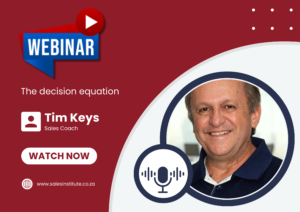
You didn’t lose to a competitor. According to Sales Institute CEO Tim Keys, you lost to indecision. And it’s far more common than most sales professionals realise.
The Science Behind the Stall
Research across more than two million sales calls has surfaced a number that should change how every salesperson thinks about their pipeline: 44% of lost deals end in no decision at all. Not a competitor win. Not a price objection. Just silence.
The reason is psychological, and it’s rooted in the same survival instincts that drive most human behaviour. The brain is wired to avoid mistakes. In a business context, that means the customer’s internal risk calculation often works against you even when they genuinely want what you’re offering.
Tim breaks this down into two distinct forces. The first is inertia, which accounts for roughly 44% of indecision. This is the status quo bias: the deeply human tendency to stay in an uncomfortable situation you know rather than risk a new one you don’t. The second is anxiety, which accounts for the remaining 56%. This is the omission bias: the fear that taking action and getting it wrong is far worse than doing nothing at all. A customer would rather look back and say “I wish I’d done that” than be the person who signed off on the failed implementation.
Understanding which force is dominant in any given deal changes everything about how you respond to it.
The Decision Equation
Tim uses a framework called the Decision Equation to map the forces at play in every deal. It breaks down into four areas.
Push factors are what’s driving the need for change: equipment that keeps failing, a current provider that isn’t delivering, a process that’s costing more than it should. Pull factors are what makes your solution attractive: the pricing, the track record, the capabilities that match what the customer needs.
On the other side sit inertia elements, the things that make staying put feel easier: long-standing relationships with the incumbent, the complexity of migrating systems, the internal effort required to manage a transition. And then anxiety elements, the specific worries keeping the customer up at night: will this actually deliver the ROI they’re promising their board, and will they personally look incompetent if it doesn’t?
A deal stalls when the right side of that equation outweighs the left. And the most common mistake salespeople make is trying to push harder on the left when the real problem is the weight on the right.
The Pivot: From Selling to De-Risking
When a customer hesitates, the instinct is to apply more pressure. Create urgency. Remind them what they’re losing by waiting. But if a customer is operating from anxiety, increasing the pressure increases the anxiety, and an anxious customer doesn’t buy. They disappear.
Tim’s research points to a critical shift that top performers make at around the 60% mark of a deal. They stop focusing on the case for change and start focusing on reducing the risk of change. The conversation moves from “here’s why you need this” to “here’s why you can feel safe saying yes.”
Making It Easier to Say Yes
The practical tools for de-risking a deal are what Tim calls Accelerators. These are resources and commitments designed to lower the stakes of the decision for the customer.
Detailed information is the first. When customers are anxious, they go quiet because they’re sitting with unanswered questions they may not even know how to ask. Proactively sharing deep-dive case studies, technical specifications, and implementation overviews removes the information gaps that feed uncertainty.
Social proof is the second. Connecting a hesitant prospect with an existing customer in a similar industry, or sharing a reference story that mirrors their specific situation, does something no sales pitch can: it lets them see that someone like them took the leap and it worked out.
Guarantees and reduced commitment structures are the third. Phased implementations, trial periods, and clearly defined exit points lower the perceived stakes of the decision. When the customer feels like they’re not betting everything on a single choice, the anxiety that’s been blocking the deal has less to hold onto.
Stop Asking “Have You Made a Decision?” and Start Asking “What Are You Worried About?”
A stagnant pipeline is rarely a pipeline of people who don’t want what you’re offering. It’s usually a pipeline of people who want it but can’t get past the fear of getting it wrong.
When you shift your focus from closing the deal to understanding what’s holding the customer back, the conversation changes. You stop being the person applying pressure and start being the person removing obstacles. That’s a fundamentally different relationship, and it’s the one that actually moves deals forward.